Find the Family of All Solutions to Ax=b
 Download Article
Download Commodity
In a cubic equation, the highest exponent is 3, the equation has 3 solutions/roots, and the equation itself takes the course . While cubics look intimidating and can in fact be quite hard to solve, using the right approach (and a good amount of foundational knowledge) tin tame even the trickiest cubics. You can try, among other options, using the quadratic formula, finding integer solutions, or identifying discriminants.

-
1
-
2
Advertizing
-
3
-
iv
-
5
Utilize zilch and the quadratic answers as your cubic'south answers. While quadratic equations take two solutions, cubics have three. You already have two of these — they're the answers yous constitute for the "quadratic" portion of the problem in parentheses. In cases where your equation is eligible for this "factoring" method of solving, your third answer will always be .[6]
Advertizing

-
1
-
2
-
three
-
4
Plug in the integers manually for a simpler simply maybe time-consuming approach. Once y'all have your list of values, you tin notice the integer answers to your cubic equation by quickly plugging each integer in manually and finding which ones equal . For instance, if you plug in , you become:[10]
-
5
Advertisement

-
1
-
2
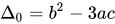
Calculate the discriminant of naught using the proper formula. The discriminant approach to finding a cubic equation's solution requires some complicated math, but if you follow the procedure carefully, you'll find that it's an invaluable tool for figuring out those cubic equations that are hard to crack any other way. To start, find (the discriminant of zip), the beginning of several important quantities we'll need, by plugging the appropriate values into the formula .[xiii]
-
3
-
4
-
5
-
6
Advertising

Add New Question
-
Question
How would I solve xy+z+z^iii=ane?

That equation has numerous answers because you've got 3 variables. To become one answer for three variables you need three equations. One possible reply would exist ten=one, y=-1, z=one => (1)(-one)+i+one^3=i.
-
Question
The question is: if iii consecutive fifty-fifty numbers are multiplied and the result would be 960. What are those numbers and how did yous did with the step?

Elvis Kiprotich
Community Answer
Solve the equation using the discriminant arroyo you will get three values of x. X=eight, X=-7+(-1i)√71, 10=-vii+i√71. Easy from here, you pick the real value of x, that'south 8 and your three numbers were 8, 10 and 12.
-
Question
Can you requite a particular formula for solving cubic equations?

Yes, but it's highly impractical to memorize or fifty-fifty use: http://world wide web.math.vanderbilt.edu/~schectex/courses/cubic/
-
Question
How can at that place exist a foursquare root of -3?

In the ordinary sense, at that place is no such matter as the square root of a negative number. Notwithstanding, mathematicians take invented the "imaginary" number known as "i", which is defined as the foursquare root of negative ane. The square root of -3 is equal to "i" multiplied by the square root of 3, or ane.73 i.
-
Question
What's the product of Alpha Beta Gamma Delta if they are the roots of the polynomial?
Hemant Dikshit
Customs Answer
It is the constant term of the polynomial. This is because Minus Blastoff x Minus Beta x Minus Gamma x Minus Delta = Plus Alpha Beta Gamma Delta.
-
Question
The link you lot gave in a higher place for a item formula for solving cubic equations but seems to give ane solution; how does one use that formula to get all 3 potential solutions?

Eric Shen
Community Reply
By the Primal Theorem of Algebra, we have ax^3 + bx^2 + cx + d, which tin be expressed equally a(x-r)(x-south)(ten-t). WLOG allow the equation give r. And then, simply divide the cubic by (x-r) and we get a quadratic whose roots are the remaining two roots.
-
Question
What is the solution to 6y3 + 4y2 -5y = ii?

ayodeji oyenaike
Customs Answer
Multiply and collect: 6y3 + 4y2 - 5y = two, therefore 21y = 2. The answer is y = 2 / 21.
-
Question
Can anyone factorize x^iii+4x-ii?
Yes. It is possible. All yous need to do is use the factoring approach, only first you must add together 2 to both sides. After, y'all can gene it to (x) (10^2 + 4) = 2. Dissever both sides past ten to go 10^2 + 4 = ii/x. Subtract four from both sides to go 10^2 = 2/x - iv. Square root both sides to go x = ±√(2x - 4).
-
Question
If N3+North=2x, how do I notice N?

Commencement simplify the equation to 4N = 2x. Then separate each side past four to get N = (2x)/(4).
-
Question
How to solve A^iii -A = threescore?

Earlier trying advanced methods like the cubic formula, exercise a quick check for rational roots -- you might go lucky. Here the Rational Roots Theorem implies than any rational roots must be integer divisors of threescore. A little trial and error then reveals 4^3 - 4 = 64-iv = threescore, so A=4 is a solution. If you crave all real and complex solutions, use the known solution to factor A^3 - A - sixty = (A-4)(A^2 + 4A + xv). The quadratic cistron has no real roots, but its two complex solutions can exist establish via the quadratic formula.


Show more answers
Ask a Question
200 characters left
Include your e-mail address to get a message when this question is answered.
Submit
Advertisement
Video
Thanks for submitting a tip for review!
About This Article
Article Summary X
To solve a cubic equation, first by determining if your equation has a constant. If it doesn't, factor an 10 out and employ the quadratic formula to solve the remaining quadratic equation. If it does have a constant, you won't be able to use the quadratic formula. Instead, find all of the factors of a and d in the equation and so carve up the factors of a by the factors of d. And then, plug each reply into the equation to come across which one equals 0. Whichever integer equals 0 is your answer. Read on to learn how to solve a cubic equation using a discriminant approach!
Did this summary help you?
Cheers to all authors for creating a page that has been read 727,324 times.
Did this article help you?
Source: https://www.wikihow.com/Solve-a-Cubic-Equation
0 Response to "Find the Family of All Solutions to Ax=b"
Postar um comentário