Cognitive Processes That Underpin the Reading and Writing Process
You probable know someone who struggles with reading. This shouldn't actually surprise united states, because reading is a complex act. Information technology involves a wide range of processes and skills that all have to act at once, in the correct mode, in lodge to achieve the desired upshot of understanding a piece of text.
For most of usa, reading involves vision. Your eyes are currently moving across this text, back and forth, quite rapidly. In addition to this, reading involves an awareness of sound. When y'all began reading this article, you may have "heard" a voice (maybe your own) reading the words to you inside your mind. To make matters even more complicated, reading relies on concepts in your mind. To take a small-scale word similar "read" as an example:
- You took in the shape of the word with your optics
- Yous connected this shape to a sound or set of possible sounds
- Yous ruled out an incorrect one like "red" and selected the right ane for this context: "read"
- You put this item into the sentence in social club to understand what the writer was telling you most reading
All of this should take happened more or less instantaneously. For some people, nevertheless, information technology doesn't. For several reasons, some people have difficulty at ane or more of the stages we described in a higher place. When this happens, it becomes hard to assemble the meaning of a text. In an historic period where reading is a vital life skill, this can crusade meaning issues.
It's important to point out that not all people who experience difficulty in reading take dyslexia. Obviously, existence able to read and write well depends on acceptable training. If yous don't receive this training, yous volition probably observe it difficult to read. Similarly, some kinds of brain injury or impairment may make complex tasks like reading hard to reach. However, when a child's reading skills lag behind their overall ability, dyslexia may be present.
But where is it present, why? In this article, we are going to consider:
- Where does the term "dyslexia" come from?
- What is dyslexia?
- How common is dyslexia?
- What are the signs of dyslexia?
- What is the impact of dyslexia?
- What causes dyslexia?
- What cognitive difficulties underpin reading?
- How is dyslexia diagnosed?
- Can dyslexia go undetected?
- What other conditions can occur with dyslexia?
- What can parents do to help their children?
- What is the best handling for dyslexia?
Where does the term "dyslexia" come from?
The term dyslexia appeared for the first time in the belatedly 19th century. Interestingly enough, an ophthalmologist came up with the term. He was working with adults who had lost their ability to read after a stroke. The term competed with "built word blindness" for some time. "Congenital" suggests an innate characteristic, and "incomprehension" suggests a deficit in something other than intelligence.
It was only some fourth dimension later, in 1968, that the World Federation of Neurology met and divers dyslexia as a disorder in these terms:
"A disorder manifested by difficulty in learning to read despite conventional didactics, adequate intelligence, and socio-cultural opportunity. It is dependent upon fundamental cognitive disabilities which are oftentimes of constitutional origin."
What is dyslexia?
Dyslexia, in the most basic terms, is a difficulty with words. Like all words that start with dys it refers to a problem, deficiency, or lack. Lexia has to practice with words and language. Information technology shares an beginnings with other words like lecture. In detail, dyslexia refers to a difficulty with reading and writing words. This ways that it'south possible for a dyslexic child to speak and understand linguistic communication effortlessly but take pregnant difficulty reading and writing the aforementioned language.
Traditionally, dyslexia has been divers in terms of a discrepancy between actual reading performance and what would be expected based on the kid's intelligence. The 'true dyslexic' was typically a person who, despite struggling with reading, is above average in intelligence. When children are less intelligent, their reading troubles take been ascribed to their full general intellectual limitations.
Research, however, has shown that the distinction betwixt the intellectually able dyslexic poor reader and the 'garden-multifariousness' poor reader with an every bit depressed cognitive contour, is no longer tenable. Using brain imaging scans, Tanaka et al. (2011) found that there was no departure between the way poor readers with or without dyslexia retrieve while reading. Research results show that poor readers of all IQ levels showed significantly less brain activeness in the half-dozen observed areas than typical readers. But at that place was no difference in the brains of the poor readers, regardless of their IQs. These findings were largely replicated by Simos et al. (2014).
The Rose Report (2009) states that dyslexia can occur across the IQ range and that poor decoding skills crave the same kinds of intervention irrespective of IQ. The Rose Report defines dyslexia as follows (p. ten):
Dyslexia is a learning difficulty that primarily affects the skills involved in accurate and fluent give-and-take reading and spelling. Characteristic features of dyslexia are difficulties in phonological awareness, verbal retentivity and verbal processing speed. Dyslexia occurs beyond the range of intellectual abilities. It is best idea of as a continuum, not a distinct category, and in that location are no articulate cut-off points. Co-occurring difficulties may exist seen in aspects of language, motor coordination, mental calculation, concentration and personal system, but these are not, by themselves, markers of dyslexia. A good indication of the severity and persistence of dyslexic difficulties can be gained by examining how the individual responds or has responded to well-founded intervention.
The DSM-5 uses the term 'Specific Learning Disorder with impairment in reading' to depict what others telephone call dyslexia. Information technology considers dyslexia "specific" for 4 reasons: it is not attributable to
- an intellectual disability, generally estimated by an IQ score of 65-75;
- a global developmental filibuster;
- hearing or vision disorders; or
- neurological or motor disorders.
Dyslexia is best idea of as a continuum, not a distinct category, and there are no clear cut-off points. Dyslexia, similar hypertension, can thus vary in severity. The terms balmy, moderate, and astringent are usually used to describe the degree:
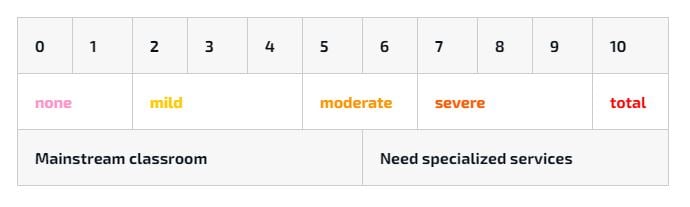
- Almost adults show some blips and would be levels 1 or two.
- Levels 4 or 5 have difficulty in spelling and punctuation. If they maintain high levels of discipline, they can be successful.
- Levels half-dozen or 7 take difficulty with spelling and reading textbooks. They tin can sometimes cease higher, but it takes tremendous effort.
- Levels 8 or nine find academic learning almost impossible. Information technology takes 2-3 times longer to terminate assignments. They need constant assistance.
The most common subtypes of dyslexia includedysphonetic (also called phonological or auditory), dyseidetic (too named surface and visual), anddeep.Developmental dyslexia may exist used to distinguish the trouble in children and youth from similar problems experienced past persons after severe head injuries.
>>>>> Learn more about dyslexia types
What are the signs of dyslexia?
The complication of learning disabilities, in full general, makes information technology difficult to pinpoint a discrete set of definitive signs. This is further complicated past the fact that some behaviors or difficulties are interpreted differently depending on age and developmental stage. However, advances in dyslexia testing have enabled clinicians to link certain traits, behaviors, and deficits to the presence of dyslexia. Hither is a list of some of the more common ones:
Linguistic signs
Children tend to develop linguistic communication in a predictable series of stages and landmarks. This process has received a great deal of attention from psychologists and linguists, and so it is fairly well understood. In that location is also a correlation between a failure to reach certain landmarks and difficulties with reading later on. While none of these are conclusive proof of dyslexia, they are worth noting if you observe them in your child:
Late language acquisition: Many dyslexic children exhibit a delay in language acquisition. Acquisition is the term linguists utilize to describe the process whereby you accept on your offset language. Children who take longer to grasp their first language may be at greater gamble of dyslexia because this tin signal a deficit in phonological awareness.
Difficulty with rhyme: Most people learn curt poems, songs, and nursery rhymes in early on babyhood. These are usually rich in rhyme, which serves ii purposes. The first is that information technology enables memorization. Information technology's easier to call up the adjacent line of a song if its end rhymes with the 1 preceding. The second is that it lays a foundation for the linking of sounds and symbols that comes subsequently on. A dyslexic child may observe it difficult to answer a question like: "tin can yous think of a word that rhymes withhot?"
Problems with literacy
One time a kid completes the process of acquiring a first language (ordinarily effectually the age of 5), literacy is introduced through elementary schooling. The child must begin to larn to translate written text. In guild for this to happen, several other mental processes must be effortless and routine. If difficulties in any of these begin to appear as a kid begins learning to read, this could indicate the demand for a dyslexia test.
Learning sound-symbol relationships: Persistent difficulty in linking letter symbols to sounds can be an early indicator of dyslexia. Some children routinely give the incorrect sound for a given alphabetic character symbol, even ones that are frequent. If this persists even when the symbol is written in large font, the problem may be a specific learning disability similar dyslexia.
Difficulty blending: In English, and many other languages, each character in a written word represents one phoneme, or sound. You lot can recall of a phoneme equally a unit of sound that bears meaning. For case, the difference between /t/ and /d/ is a salient one for English speakers: "debt" and dead" are pronounced in similar ways, only the ending of the give-and-take differs – but the ending changes the meaning. To successfully deal with a word, a beginning reader must "alloy" the sounds represented by the various symbols: the sequence t – a – p must become a single sound: "tap". Dyslexia can make it difficult for the young reader to do this, even for very unproblematic words.
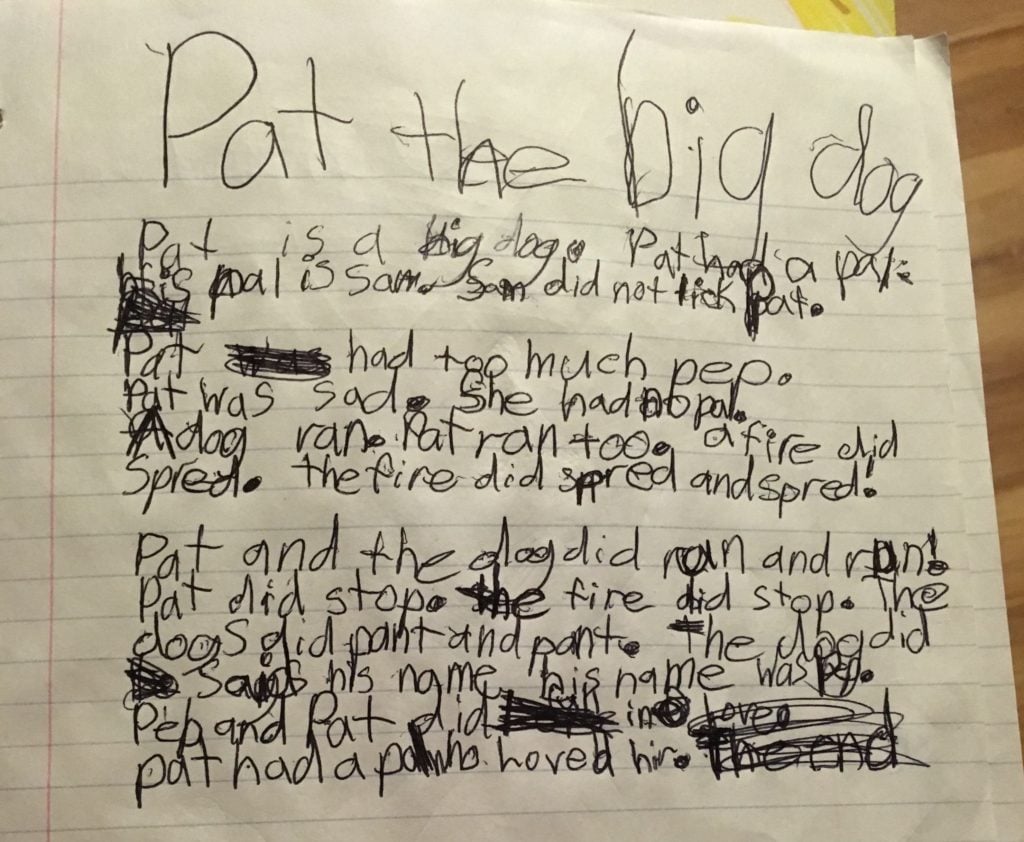
Difficulty substituting sounds: Just every bit they may struggle to blend sounds into words, dyslexics frequently exercise not readily do the reverse task of breaking words into carve up sound segments. A task such as irresolute one sound for some other may exist very difficult: "change the 't' in 'tap' into a 'k' to make a new word".
Reading for comprehension: Constructive reading involves more than accurate decoding of the text. The reader must empathise what the text is saying. For this to happen, the reader must move at the right pace: too boring, and important information will be forgotten. Too fast, and the brain volition not have adequate time to get together pregnant. Furthermore, the effort of decoding the words should non be so swell that information technology leaves no time and free energy for interpretation. Dyslexics, even those who are able to read adequately, might accept meaning difficulty putting the meaning of a text together. In young children, this tin manifest in an inability to answer even very unproblematic comprehension questions later reading a story.
Behavioral signs
In addition to language and literacy skills, a child's behavior and not-verbal abilities can provide useful information about hereafter reading outcomes. As with the previous examples, these are not conclusive, and y'all should not think of them as definite symptoms of dyslexia. Just they are worth noting, and yous should inform the examiner or assessor if y'all procure a dyslexia examination for your child later on.
Retaining heard information: Dyslexic children often neglect to follow verbal instructions. This can hands be mistaken for defiance or a deficit in hearing. Only information technology might signal a arrears in auditory memory, which is a crucial attribute of learning.
Motor skills: There appears to be a high charge per unit of coincidence between dyslexia and difficulties with motor skills. These are the skills that nosotros recruit in society to do things like sit and balance (gross motor), or agree and manipulate paper and pencils (fine motor). Dyslexic children frequently exhibit poor or beneath-boilerplate motor skills, which suggests a link between the two. Even though this isn't very well understood, bug with concrete command tin be an early sign of a specific learning disability such equally dyslexia or dysgraphia.
>>>> Learn more nearly dyslexia symptoms and signs
How common is dyslexia?
It can be hard to ascertain whether a child is dyslexic. As a result, determining exactly how many people are dyslexic is a catchy thing. This is because the definition of dyslexia, as we have seen, is not precise in the way that many other disorders are. What unifies all dyslexic people is that they find it difficult to read effectively for understanding. But this tin mean many things. For some, it ways they struggle particularly with certain letter symbols. For others, it might mean that they can identify individual words but can't read fluently. Others tin read moderately well but without understanding.
Information technology'southward difficult to go far at a concrete figure, simply dyslexia seems to bear on a big number of people. Most estimates place the number at between 4 and 12 percent of a population. According to the International Dyslexia Association, at least ane in every ten otherwise able people has serious dyslexia problems.
What is the impact of dyslexia?
Poor reading skills bandage a night shadow. At that place is extensive testify suggesting that learning to read is straight linked to a young child'south self-concept and mental well-existence, and that children with hampered reading skills fare poorly academically. Equally the poor achiever's hope for a fulfilling and productive life starts to diminish, they may start contributing to the overall numbers of schoolhouse dropouts, unmarried parents, juvenile delinquents, and imprisoned adults. As many as 75% of those incarcerated in the The states have not graduated from high schoolhouse, and lxx% are functionally illiterate and read below a fourth-form level. In addition, underemployed and unemployed adults constitute a significant percentage of children who once failed to acquire functional levels of literacy.

Reading failure increases the risk of depression equally well equally suicidality. Fuller-Thomson et al. (2018) conducted a large representative survey of customs-dwelling Canadians, which showed that ane in every six women and i in every nine men with specific learning disorders (SLDs) had attempted suicide. Dyslexia or reading disability is the most mutual SLD, comprising 80% of all diagnosed SLDs. Fuller-Thomson et al. ended that people with SLDs had 46% college odds of having ever attempted suicide in comparison with their peers without SLDs, even later controlling for many of the known chance factors for suicide attempts.
Stiff reading skills, on the other hand, have been tied to many personal, social and economic benefits. In a large, population-representative sample from the United kingdom of great britain and northern ireland, reading ability at the early on age of seven was linked to socio-economic status at age 42. Participants who had college reading skills every bit children had higher incomes, better housing, and more desirable jobs in adulthood. The data suggest, for example, that achieving one reading level higher at age seven was associated with a £5,000 increase in income at the historic period of 42.
What causes dyslexia?
Some research suggests that dyslexia has a neurobiological basis. This means that its cause is in the brain. The cerebellum, a brain structure traditionally considered to be involved in motor role, has been implicated in developmental dyslexia. New research, however, shows that the cerebellum is non engaged during reading in typical readers and does not differ in children who have dyslexia (Ashburn et al., 2019).
In a meta-analysis of functional neuroimaging studies of dyslexia, Martin et al. (2016) list studies in which differences between groups with and without dyslexia were found in specific encephalon regions. The most consistent findings concerned theleft occipitotemporal cortex, which includes the so-calledvisual word class area(VWFA), though to exist disquisitional for reading.
Theleft inferior parietal lobule came in a close 2nd in the meta-analysis written report by Martin and colleagues. This part of the brain is said to be involved in give-and-take analysis, grapheme-to-phoneme conversion, and full general phonological and semantic processing. Imaging also reveals compensatory overactivation in other parts of the reading system. The compensatory neural systems allow a dyslexic person to read more accurately. Withal, the critical visual discussion-class area remains disrupted and difficulties with rapid, fluent, automatic reading persist. The dyslexic continues to read slowly.
A neurological footing goes some way in explaining why some children neglect to achieve despite having adequate grooming and support. It also provides a style to make sense of the mutual occurrence of dyslexia within families. A big-scale report of twins with dyslexia yielded a concordance rate of 68% in identical twins, as compared with 38% in non-identical twins, indicating a substantial genetic component (DeFries & Alarcón, 1996).
It should be noted that brain differences practice not equal encephalon disorders (Protopapas & Parrila, 2018), and some studies advise that the cause-result relationship is reversed, in other words, that anatomical brain differences are not the cause of reading difficulties, just the consequence (Krafnick et al., 2014). It should also be noted that the brain is plastic, which means that it is constantly changing as a result of learning, feel, and retentivity germination.
Named neuroplasticity, this scientific discipline has plant that new brain cells are constantly existence built-in and die, new connections can class, and the internal structure of the existing synapses can change. In 90 percent of people, the left hemisphere controls the capacity to understand and generate language. Even if the left hemisphere of a person's encephalon is severely injured, the right side of the brain can take over some linguistic communication functions. When a person becomes an expert in a specific domain, he volition have growth in the areas of the encephalon that are involved in that particular skill.
Although some causes of dyslexia have a genetic origin, and environmental factors play an important part, knowledge mediates encephalon-behavior relationships and therefore offers a sufficient level of explanation for the development of principled interventions. We thus need to understand the cognitive difficulties that underpin reading failure, regardless of whether their origin is ramble or environmental (Elliott & Grigorenko, 2014).
>>>> Larn more about dyslexia causes
What cognitive difficulties underpin reading failure?
Di dunia kini kita, tiap orang harus dapat membaca….
Unless i hasfirstlearned to speak Bahasa Indonesia, there is no style that one would exist able to read the above Indonesian judgement.
This shows that language is at the very bottom of the reading ladder. Its role in reading can be compared to the role of running in the game of soccer or ice-skating in the game of ice hockey. One cannot play soccer if i cannot run, and one cannot play ice hockey if one cannot skate. One cannot read a book in a language – and least of all write – unless one knows the detail language.
While language skills incorporate the first rung of the reading ladder, cognitive skills comprise the 2d. Multiple cerebral skills are involved in learning to read, spell and write. Below are examples:
Phonological awareness
Phonological awareness (PA) is normally divers as the ability to identify and consciously manipulate the sound units of language. It is a listening skill that includes the power to distinguish units of speech, such equally rhymes, syllables in words, and individual phonemes in syllables. Phonological awareness is ofttimes dislocated with phonics, but it is different. Phonics requires students to know and lucifer letters or alphabetic character patterns with sounds, learn the rules of spelling, and utilize this information to decode (read) and encode (write) words. Phonological awareness relates only to spoken language sounds, not to alphabet letters or sound-spellings, so students don't need to have alphabet knowledge to develop a basic phonological sensation of language.
The PA-reading relationship has been extensively studied. For years, enquiry has promoted the idea that explicit awareness of phonemes is crucial for reading development.
Rapid automatized naming
Research on rapid automatized naming (RAN) began with the work of Denckla and Rudel. RAN refers to the speed with which the names of symbols (letters, numbers, colors, or pictured objects) can be retrieved from long-term memory. People with dyslexia typically score poorer on RAN assessments than normal readers.
A meta-assay of 137 studies of 28,826 participants indicated a moderate-to-strong relationship between RAN and reading operation. Farther analyses revealed that RAN contributes to the four measures of reading (word reading, text reading, non-give-and-take reading, and reading comprehension), but higher coefficients emerged in favor of real-discussion reading and text reading. The authors conclude that there is "yet no consensus regarding the mechanisms responsible for this relationship" (Araújo et al., 2015, p. 869).
Processing speed
Processing speed can exist defined equallyhow long it takes to get stuff done.
Dyslexia is linked to slow processing speed. Sigmundsson and his colleagues at the Norwegian University of Science and Technology in Trondheim gave two simulated driving tests to six dyslexic volunteers and eleven other people. They were shown road signs as they collection on simulated country and metropolis roads at different speeds.
The researchers institute that the drivers with dyslexia were 20 per centum slower to react to traffic signs during the rural bulldoze and 30 percentage slower to react in the city than the non-dyslexic controls.
Auditory working retentiveness
The termworking retentivenesswas coined in the 1970s by two researchers named Baddeley and Hitch, referring to the ability to temporarily hold several facts or thoughts in memory while solving a problem or performing a job. You use this workspace in your brain when mentally adding or subtracting two or more than numbers.
Weiss and colleagues (2014) tested 52 musicians, of which 24 accept dyslexia and 28 who don't, and compared the functioning of the two groups in a variety of auditory tests. On well-nigh tests of auditory processing, the dyslexic musicians scored likewise as their nondyslexic counterparts, and amend than the full general population. Where they performed much worse was on tests of auditory working memory, including memory for rhythm, melody, and speech communication sounds. Moreover, these abilities were intercorrelated, and highly correlated with their reading accuracy, which means that the dyslexic musicians with the poorest working retentiveness tended to have the everyman reading accuracy. Those with meliorate working retention tended to exist more than accurate.
An important and consequent finding is that working retention problems interfere with reading comprehension. Reading is a circuitous skill that requires the simultaneous activation of many unlike brain processes.
Visual retentivity
Visual memory involves the ability to store and retrieve previously experienced visual sensations and perceptions when the stimuli that originally evoked them are no longer present. That is, the person must be capable of making a vivid visual paradigm in his heed of the stimulus, such every bit a word, and one time that stimulus is removed, to be able to visualize or recall this prototype without help.
Strong visual memory is a critical skill for word recognition. Skilled readers can recognize words at a lightning-fast speed when they read because the words have been placed in a sort of "visual dictionary." The visual dictionary idea rebuts the theory that our brain "sounds out" words each fourth dimension we see them.
Glezer and her coauthors (2016) tested word recognition in 27 volunteers in two dissimilar experiments using fMRI. They were able to meet that words that are unlike merely sound the same (like "hare" and "hair"), activate unlike neurons, alike to accessing different entries in a dictionary's itemize. If the sounds of the word influenced this office of the brain we would wait to come across that they activate the same or similar neurons, but this was not the instance; 'hair' and 'hare' looked just equally unlike as 'hair' and 'soup'. This suggests that, once we know a word, nosotros use the visual information of a word and not the sounds. Too, the researchers found a dissimilar distinct region that was sensitive to the sounds, where 'hair' and 'hare' did look the same.
Sequential retention
Sequential memory requires items to exist recalled in a specific society. In saying the days of the week, months of the year, a telephone number, the alphabet, and in counting, the guild of the elements is of paramount importance.Visual sequential memory is the ability to remember things seen in sequence, whileauditory sequential memory is the power to remember things heard in sequence.
Since every word consists of messages in a specific sequence, sequential memory is of great importance in the reading process. To read one has to perceive the letters in sequence, and also call up what word is represented by that sequence of letters. By just changing the sequence of the letters inname, it tin becomemeanoramen.
Guthrie and Goldberg investigated relationships between visual sequential memory and reading in 81 normal and 43 disabled readers. The children had normal intelligence and a hateful reading class of 2.5. The mean chronological age of the normal readers was 8.5 years, and the mean of the reading disabled 10.3. Partial correlations between 3 tests of visual sequential retentivity and iii tests of reading were computed. Meaning, positive associations were identified between visual sequential memory and paragraph comprehension, oral reading, and word recognition.
A report past Stanley et al. compared 33 dyslexic and 33 control eight- to 12-year-old children and found the dyslexic children to be inferior to controls on tasks involving visual sequential memory and auditory sequential retentivity.
Logical thinking
Logical thinking is the process in which one uses reasoning consistently to come to a conclusion. Problems or situations that involve logical thinking call for structure, for relationships between facts, and for chains of reasoning that "make sense."
The relationship between logical thinking and reading comprehension is well established in the literature. It has been said that "there is no reading without reasoning," and fifty-fifty that readingisreasoning.
How is dyslexia diagnosed?
A diagnosis of dyslexia tin can only be made after an extensive evaluation. This evaluation looks at a kid'southward ability to read, in addition to other factors such as general bookish ability and family unit background. Typically, a large amount of information is required and the person administering the evaluation or assessment will take the kid through a series of tests. This thoroughness is necessary because it'due south important to rule out other possibilities.
Remember, information technology's possible for someone to read poorly and non be dyslexic. A child may take a confusing home life that has fabricated learning difficult. Or, in that location might be a significant intellectual harm. Neither of these is the same every bit dyslexia. To eliminate these and other possibilities, an cess must have a wide range of information into account.
In many countries, the ability to diagnose dyslexia is limited to certain qualified professionals. In the United states of america, there is no overarching law that defines who may provide a diagnosis. Generally, however, in that location is an understanding that one test on its own cannot be an adequate footing for a dyslexia diagnosis. For example, an audiologist may determine that a kid has difficulty with auditory processing. This may be the cause of a child's reading difficulty, but it is unwise to presume and then based on ane test solitary. The practitioners and clinicians who typically give dyslexia diagnoses utilize a battery of tests and measurements.
>>>> Learn more about diagnosing dyslexia
Can dyslexia go undetected?
Sometimes, specific learning disabilities like dyslexia can be hard to detect. Some children evade a diagnosis because they accept exceptional abilities and can therefore mask their dyslexia. They feature in the literature every bit "twice exceptional" cases, because they are to a higher place average in ability and intelligence, while living with specific learning disabilities. Another common term is "stealth dyslexia," Some signs of this include:
- A pregnant difference between verbal expression (high) and writing power (low)
- Extremely illegible handwriting
- A tendency to "supply" words rather than reading what is actually on the page
Children in this category often underachieve despite their high intelligence and sophisticated problem-solving abilities. If there is a substantial and unaccountable gap between your child's ability and your child'southward achievement at school, it might be unwise to rule out dyslexia every bit an underlying cause.
What other conditions tin occur with dyslexia?
Equally various fields of study converged on the problem of dyslexia, experts began to notice relationships betwixt dyslexia and other weather. In many cases, a person who has dyslexia volition also experience at to the lowest degree 1 other condition or disorder.
Practitioners telephone call these Specific Learning Disorders (SLDs) and estimate that the co-occurrence of conditions is actually typical. More often than not, practitioners and clinicians talk about "co-occurrence," which avoids the difficult question of whether one causes the other. The most of import thing for parents to know is that a dyslexic kid might experience more than one SLD. Some of the more well known of these are:
Attending Arrears Hyperactivity Disorder (ADHD): Children who show difficulty concentrating, resisting impulses, or completing tasks may receive a diagnosis of Attention Arrears Disorder (Add together) or Attending Arrears Hyperactivity Disorder (ADHD). There is a wide range of opinions on the causes and treatment of ADHD, but information technology is articulate that poor impulse command has a major upshot on learning in general, and cognitively demanding tasks like reading in particular.
Dyscalculia: Dyscalculia is a term used to describe difficulties with number concepts and math. Children with this trouble may have difficulty performing basic mathematical operations. At a more bones level, they might find it hard to retrieve objects in a sequence or recognize patterns.
Dysgraphia: The term dysgraphia is used to describe a variety of difficulties with writing. In young children, these include issues with holding a pencil, forming messages, and spelling words correctly. Dysgraphic writing oft contains irregular letter spacing and sizing. Words and sentences may also appear skewed, rather than formed in a straight line. In older children, it tin can manifest in a tendency to write sentences that are either grammatically incorrect or incomplete.
Dyspraxia: Dyspraxia refers to difficulty with coordination and motion. Information technology is also classified as Developmental Coordination Disorder (DCD). Children who receive a diagnosis of dyspraxia typically have difficulty manipulating objects with their hands, or moving in a deliberate and coordinated way. This shows up in tasks such as climbing stairs or skipping. Children who lag behind developmental milestones such equally crawling may exist at adventure of dyspraxia. Many of the symptoms that older children nowadays are the same as those of other specific learning disabilities, such equally difficulty concentrating or completing tasks.
What can parents do to aid their children?
If your child is having trouble learning to read, the best approach is to take firsthand activeness. Ninety-five per centum of poor readers tin can be brought up to grade-level if they receive effective help early. The longer you wait to get help for a kid with reading difficulties, the harder it volition be for that child to catch upward.
Reading consultant Susan Hall urges parents to trust their intuition. "I have listened to parent after parent tell me about feeling in that location was a problem earlier on, yet being persuaded to discount their intuition and wait to seek help for their kid," she says. "Later, when they learned time is of the essence in developing reading skills, the parents regretted the lost months or years."
What is the best treatment for dyslexia?
The best treatment for dyslexia combines cognitive skills preparation with didactics decoding and the development of orthographic mapping. Decoding is a key skill for learning to read, and involves taking apart the sounds in words (segmenting) and blending sounds together. The process of orthographic mapping involves the brain linking the three forms of a word — its sounds, spelling, and pregnant — and storing them together in long-term memory. It allows for instant word recognition, fluent reading, and accurate spelling.
Edublox Online Tutor is an online platform that houses a range of products and services to improve various aspects of learning. Our programs include Development Tutor, Reading Tutor, and Alive Tutor. Alive Tutor combined with Development Tutor is recommended for students with mild to astringent dyslexia, and targets:
- strengthening cognitive skills;
- pedagogy decoding; and
- developing orthographic mapping.
.
Watch our playlist of client reviews and meet how Edublox training and tutoring tin assist plow dyslexia around.
Volume a free consultation to discuss your kid'south learning needs.
Authored by Susan du Plessis (B.A. Hons Psychology; B.D.), an educational specialist with thirty+ years' experience in the field of learning disabilities, and Dylan Arslanian (B.A. Hons Linguistics, Cambridge DELTA).
Medically reviewed by Dr. Zelda Strydom (MBChB).
.
References and sources:
American Psychiatric Association (2013).Diagnostic and statistical manual of mental disorders (5th ed.). Washington, DC, American Psychiatric Publishing.
Araújo, S., Reis, A., Petersson, Yard. M., & Faísca, Fifty. (2015). Rapid automatized naming and reading operation: A meta-analysis. Journal of Educational Psychology, 107(three), 868–883.
Ashburn, S. 1000., Ashburn, S. M., Flowers, D. L., Napoliello, Eastward. Yard., & Eden, G. F. (2019). Cerebellar office in children with and without dyslexia during unmarried discussion processing.Human Encephalon Mapping.
Clark, Chiliad., & Gosnell, M. (1982, March 22). "Dealing with dyslexia,"Newsweek, 55-56.
DeFries, J. C., & Alarcón, M. (1996). Genetics of specific reading inability. Mental Retardation and Developmental Disabilities Research Reviews, 2, 39–47.
Draganski, B., Gaser, C., Busch, V., Schuierer, M., Bogdahn, U., & May, A. (2004). Neuroplasticity: Changes in greyness matter induced by training.Nature,427, 311-312.
Elliott, J. G. (2015). The dyslexia debate: Deportment, reactions, and over-reactions.Psychology of Instruction Review, 39(i), 6-sixteen.
Elliott, J. G., & Grigorenko, E. 50. (2014).The dyslexia debate. Cambridge: Cambridge Academy Press.
Fuller-Thomson, Due east., Carroll, S. Z., & Yang, W. (2018). Suicide attempts among individuals with specific learning disorders: An underrecognized event. Periodical of Learning Disabilities, 51(3), 283-292.
Glezer, 50. Due south., Eden, G., Jiang, 10., Luetje, M., Napoliello, E., Kim, J., & Riesenhuber, M. (2016). Uncovering phonological and orthographic selectivity across the reading network using fMRI-RA.Neuroimage,138, 248-256.
Guthrie, J. T., & Goldberg, H. K. (1972). Visual sequential retention in reading inability.Journal of Learning Disabilities.
Hinshelwood, J. (1907). Iv cases of congenital give-and-take-incomprehension occurring in the same family unit.The British Medical Journal, 2(2444): 1229-1232.
Hinshelwood, J. (1917). Built word-incomprehension. London: Lewis.
Hornsby, B. (1984).Overcoming dyslexia.Johannesburg: Juta and Company Ltd.
Kerr, J. (1897). School hygiene, in its mental, moral, and concrete aspects. Howard Medical Prize Essay: June 1896.Periodical of the Royal Statistical Society, 60, 613-680.
Krafnick, A. J., Flowers, D. L., Luetje, M. M., Napoliello, Due east. M., & Eden, 1000. F. (2014). An investigation into the origin of anatomical differences in dyslexia.Journal of Neuroscience,34(three), 901-908.
Lallier, M., Lizarazu, 1000., Molinaro, N., Bourguignon, Thousand., Ríos-López, P., & Carreiras, One thousand. (2018). From auditory rhythm processing to graphic symbol-to-phoneme conversion: How neural oscillations can shed calorie-free on developmental dyslexia. In T. Lachmann, & T. Weis (Eds.).Reading and dyslexia (pp. 141-157). Cham, Switzerland: Springer.
Lopes, J. (2012). Biologising reading problems: The specific case of dyslexia.Gimmicky Social Science,7(2), 215-229.
Lyon, R. (2001). Measuring success: Using assessments and accountability to raise student achievement. Retrieved April 22, 2021 from http://projectpro.com/ICR/Inquiry/Releases/NICHD_Testimony1.htm
Maguire, E. A., Gadian, D. G., Johnsrude, I. S., Good, C. D., Ashburner, J., Frackowiak, R. South. J., & Frith, C. D. (2000). Navigation-related structural modify in the hippocampi of taxi drivers.Proceedings of the National University of Sciences of the United states of America,97(8), 4398-4403.
Maguire, E. A., Woollett, K., & Spiers, H. J. (2006). London taxi drivers and double-decker drivers: A structural MRI and neuropsychological assay London taxi drivers and omnibus drivers.Hippocampus,16(12), 1091-1101.
Martin, A., Kronbichler, Chiliad., & Richlan, F. (2016). Dyslexic encephalon activation abnormalities in deep and shallow orthographies: A meta-analysis of 28 functional neuroimaging studies.Human Encephalon Mapping, 37, 2676–2699.
Mather, Due north., & Wendling, B. J. (2012).Essentials of dyslexia assessment and intervention. Hoboken, NJ: Wiley.
Mechelli, A., Crinion, J. T., Noppeney, U., O'Doherty, J., Asburner, J., Frackowiak, R. Due south., & Price, C. J. (2004). Structural plasticity in the bilingual brain.Nature,431, 757.
Miller, J. F. (2015).Practice you read me? Learning difficulties, dyslexia, and the denial of meaning. London: Karnac Books.
Morgan, W. P. (1896). A case of congenital discussion blindness.The Lancet,two(1871), 1378.
Protopapas, A., & Parrila, R. (2018). Is dyslexia a brain disorder?Brain Sciences,8(4).
Rose, J. (2009).Identifying and teaching children and immature people with dyslexia and literacy difficulties. DCSF Publications.
Ritchie, S. J., & Bates, T. C. (2013). Indelible links from childhood mathematics and reading achievement to adult socioeconomic status. Psychological Scientific discipline, 24(vii),1301-1308.
Shaywitz, S. (2005).Overcoming dyslexia: A new and complete science-based programme for reading bug at any level. New York: Vintage Books.
Sigmundsson, H. (2005). Practise visual processing deficits cause trouble on response time chore for dyslexics?Brain and Cognition, 58(two), 213–216.
Simos, P. K., Rezaie, R., Papanicolaou, A. C., & Fletcher, J. M. (2014). Does IQ touch on the functional brain network involved in pseudoword reading in students with reading disability? A magnetoencephalography study.Frontiers in Homo Neuroscience,7(932).
Spalding K. L., Bergmann O., Alkass K., Bernard S., Salehpour M., Huttner H.B., … Frisén J. (2013). Dynamics of hippocampal neurogenesis in developed humans.Cell,153(6), 1219-1227.
Stanley One thousand., Kaplan I., & Poole C. (1975). Cognitive and nonverbal perceptual processing in dyslexics.Journal of General Psychology,93(1), 67-72.
Stein, J. (2001). The magnocellular theory of developmental dyslexia.Dyslexia,7, 12–36.
Stephenson, Southward. (1907). 6 cases of congenital word-blindness affecting three generations of 1 family.Ophthalmoscope,5, 482–484.
Tanaka, H., Black, J. M., Hulme, C., Stanley, 50. M., Kesler, S. R., Whitfield-Gabrieli, S., … Hoeft, F. (2011). The brain footing of the phonological deficit in dyslexia is independent of IQ.Psychological Science,22(xi), 1442-1451.
Thomas, C. J. (1905). Congenital 'word-blindness' and its treatment.Ophthalmoscope, 3, 380–385.
Weiss, A. H, Granot, R. Y., & Ahissar, M. (2014). The enigma of dyslexic musicians.Neuropsychologia,54, 28-xl.
Wydell, T. North., & Fern-Pollak, L. (2012). Preface. In T. N. Wydell, & L. Fern-Pollak (Eds.)Dyslexia – A comprehensive and international approach (pp. IX-XI). Rijeka, Croatia: InTech.
Source: https://www.edubloxtutor.com/understanding-dyslexia/
0 Response to "Cognitive Processes That Underpin the Reading and Writing Process"
Postar um comentário